The Door's Footprint: Matching Garage Door Movement to Your Driveway

Most garage door buying conversations start with the opening: width, height, material, colour. That is understandable. The door has to fill the hole. But the hole is only half the story. A garage door is a moving object, and every type moves differently. Some sweep out across the driveway. Some slide back into the garage. Some coil up above the opening. If you choose a door without thinking about that movement, you can end up with a perfectly sized door that makes reversing off the drive a daily puzzle.
Start with the hole, then measure the air
Before requesting quotes, measure the clear space in front of the garage. Not just the width of the driveway at the kerb, but the depth from the garage aperture to the boundary, the parked car, the bin store or the neighbour's wall. Think about the route you actually use: the school run reverse, the bike you wheel out on a Sunday, the wheelie bin on collection day. A door that fits the aperture but leaves you squeezing past a wing mirror is not really the right door.
It helps to treat the door's movement as a footprint on the ground. Some footprints are shallow. Some are deep. Some are mostly indoors. The trick is matching the footprint to the space you have, not forcing the space to suit a door you liked in a brochure.
Up-and-over canopy doors: the outward nudge
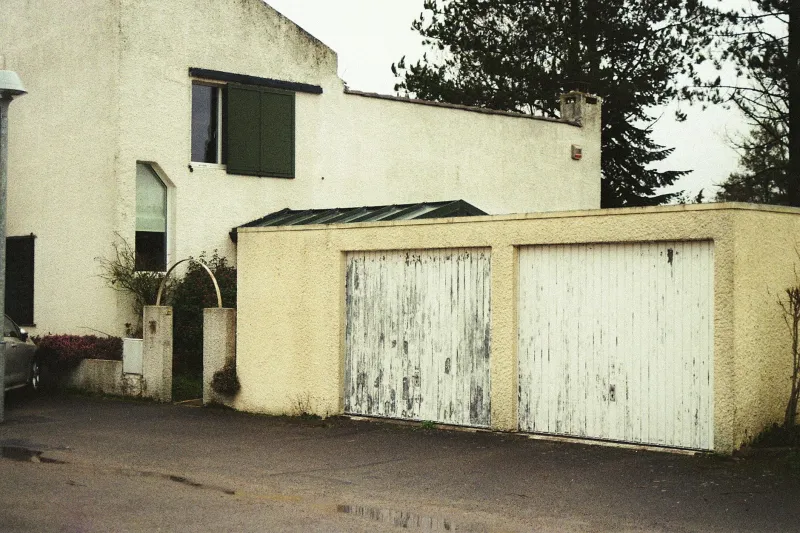
A canopy up-and-over door is the classic British garage door. When it opens, the panel swings outward and upward, and the top section projects beyond the garage opening like a small canopy. That projection is usually a few hundred millimetres, but it still counts. If your driveway is short, or if you park close to the garage door, that outward movement can put the door panel near the car bonnet.
Canopy doors also need a reasonably level patch of ground immediately in front of the opening. If the driveway slopes up towards the garage, the bottom edge of the door can foul the surface as it swings. A slight fall away from the garage is usually less troublesome, but it is worth checking with a spirit level or a football. If the ball rolls towards the door, pay attention.
Retractable up-and-over doors: the quiet insider
A retractable up-and-over door also swings out slightly at the start, but most of its movement happens inside the garage as the panel retracts along tracks. That makes it a friendlier choice for shorter driveways. The trade-off is internal space: the door needs headroom and clear area inside the garage, so it is less suitable for a garage already packed to the roof with shelving, bikes and camping gear.
This is where a lot of homeowners get caught out. They measure the outside, order a retractable door, then discover the tracks need more room inside than the old canopy door did. If you use the garage as a workshop or store, check the internal clearance before you commit.
Sectional doors: vertical retraction, indoor demands
A sectional door is made of horizontal panels that rise vertically and then run back into the garage along overhead tracks. From the driveway, it looks neat: no outward swing, no arc to keep clear. That makes it a strong option for tight forecourts and homes where the car sits close to the garage.
The catch is inside. Sectional doors need headroom for the tracks and panels, and they need side room for the vertical tracks. In a garage with a low ceiling or a structural beam just inside the opening, a sectional door may not be straightforward. It is not a reason to rule one out, but it is a reason to have someone look properly rather than ordering from a catalogue measurement alone.
Roller doors: coils above, no swing
A roller door coils up above the opening, so it does not project into the driveway at all. That can be a real advantage on a narrow drive or where the garage sits right on the boundary. It also tends to be a practical choice for people who want to maximise driveway space.
Again, the demand is internal. The roller mechanism needs headroom above the opening, and the box or hood has to fit. If the garage ceiling is low, or if there is a flat roof structure that leaves little room, a roller door may not be the simple answer it first appears. It is worth checking the internal height as carefully as the external width.
Side-hinged doors: the arc you must keep clear
Side-hinged garage doors are the closest thing to a pair of big shed doors. They swing outward on hinges, and each leaf sweeps a quarter-circle as it opens. That arc is the footprint. If you have a double garage with two wide leaves, you need clear space in front of each leaf, roughly equal to the leaf width, to open them fully.
On a wide driveway with nothing in the way, side-hinged doors are charming and practical. On a tight urban drive with a car parked close and a wall opposite, they can be awkward. You can open one leaf instead of both, but that changes how you use the garage. If bikes, bins or a pushchair need to go in and out regularly, a door that only opens halfway is a daily annoyance.
Slope, kerbs and the parked car
The surface in front of the garage matters as much as the dimensions. A driveway that slopes towards the garage can interfere with a canopy door's swing. A driveway that falls away sharply can make side-hinged leaves awkward to control. A dropped kerb or a tight turning circle can affect how you position the car while the door is opening.
Then there is the parked car. Most of us do not park with millimetre precision every evening. If the door needs a clear metre in front of it, but the car normally sits half a metre away, the door will be a nuisance. Measure the space with the car in its usual spot, not with the drive empty. That is the honest test.
Three driveway checks before you request quotes
First, mark the swing. For a canopy or side-hinged door, chalk the likely arc on the ground and see what it touches. Second, check the slope. Put a spirit level or a ball on the driveway just outside the garage and watch which way it goes. Third, walk the route. Wheel the bin out, push the bike out, imagine reversing off the drive in the rain. If any of those feel tight now, a bigger or differently moving door will not make them easier.
What to tell a surveyor or fitter
When you ask for quotes, do not just give the opening size. Mention the driveway depth, the slope, where the car usually sits, and whether you need to get bikes or bins past the door. A good fitter will appreciate the detail because it helps them recommend a door that suits the whole space, not just the hole. It also gives you a fair way to compare quotes: two prices for the same-sized door can hide very different assumptions about clearance.
The right garage door is the one that fits the opening and the life you live in front of it. Measure the hole, but measure the air as well. That is where the daily difference lies.