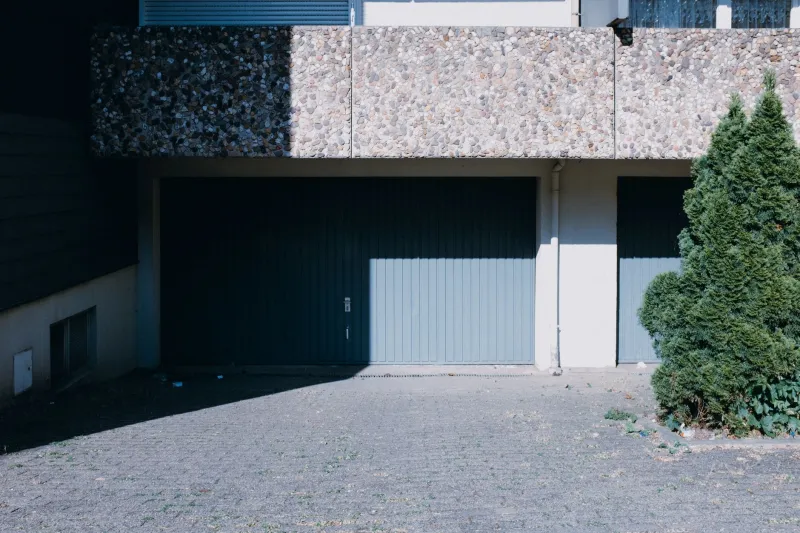
The Pavement Test: Auditing Your Garage Door the Way a Buyer Sees It

Photo by Photo by Annie Spratt on Unsplash on Unsplash
Nobody stands at the kerb counting your downpipes. But almost everyone driving past, scrolling a listing, or turning up for a viewing registers the garage door in about the time it takes to read a road sign. It is usually the biggest uninterrupted rectangle on the front of a UK home — bigger than most bay windows, bigger than the front door by a factor of three or four — and yet it's the bit owners stop looking at first. You see it every day; you stop seeing it. Buyers don't have that problem.
This is a kerb-appeal audit, not a sales pitch. Some of what follows is a tenner and an afternoon. Some of it is the honest signal that a replacement makes more sense than another patch-up.
Start where they start — on the pavement, not the drive
We all instinctively judge our own house from the drive, six feet away, at eye level, in the middle of the day. That's the most flattering angle available. Try the opposite: stand on the pavement, directly opposite the middle of the door, and look. Then walk twenty paces along the road and glance back the way a passer-by would.
Two things tend to happen. First, you notice the door is a larger share of the elevation than you remembered. Second, the small faults vanish and the structural ones — a lean, a sag, a panel that's lost its line — become obvious. Those are the ones that cost money. The small ones cost pride.
Winter light is a brutally honest inspector
We're writing this in mid-November, which is fortunate, because flat grey light tells the truth in a way July sun never will. Low, diffuse light picks out fading, patchy colour and the grubby tide-mark along the bottom rail where road spray lands. It also makes a slightly mismatched trim or a cream door against a white frame read as a deliberate mistake rather than a near-miss.
Do the audit at about 3pm on a dull day and take a photo on your phone. Photographs flatten everything into the same two dimensions a buyer's first impression uses. If it looks tired on a six-inch screen, it looks tired from a car.
Quick checklist worth doing while you're out there:
- Does the door's colour still match the fascia, the windows and the front door, or has one of them drifted?
- Is the frame trim the same shade along the top, the sides and the bottom? Odd pieces of trim are a classic 'fitted in stages' giveaway.
- Are the hinges, handle and lock all the same finish, or has one been replaced in a different metal?
- Does the door sit flush and level in its opening, or does one corner stand proud of the frame?
- Is there a visible gap at the top or along one side that wasn't there two winters ago?
The details that do the actual damage
A buyer won't diagnose a worn spring, but they will register 'this looks neglected' and carry that feeling into the kitchen. The specifics that do the most harm are unglamorous:
A faded or chalky finish. GRP and older steel doors go dull long before they fail. On a coloured door, a chalky surface reads as grey-once-blue and instantly ages the house.
Panel dents and creases. One small dent in an otherwise tidy door is character. A scattering of them along the bottom third — usually from a wheelie bin or a bike — reads as a door that's been losing a fight for years.
A door sitting proud of its frame. This is the one to take seriously. It usually points to tired springs, a distorted panel or a frame that's moved. It also looks wrong in a way viewers can't articulate but definitely feel.
Staining and rust blooms at the bottom rail. Common on older steel doors where water sits. Surface rust is cosmetic; perforation and bubbling under the paint is not.
Weeds in the track and a mossy threshold. Cheap to fix, disproportionately damaging. It suggests the whole house gets the same level of attention.
The wrong proportions. A single door on a double garage, or a pair of mismatched doors on a modern elevation, will never look right no matter how well maintained. That's a design problem, not a maintenance one.
What the estate agent's photographer will do to it
Listing photos are shot wide, low and frequently in the late afternoon. That combination exaggerates the width of the elevation and puts the garage door squarely in the foreground of the exterior shot — often the first image a buyer sees. Anything reflective, chalky or slightly off-colour will flare or dull in a way the human eye forgives and a camera doesn't.
It's also worth knowing that Rightmove and Zoopla thumbnails crop hard. Your door may end up as a strip of colour a few millimetres tall. If that strip is a faded, mismatched blue against warm brick, it's doing quiet damage to every click-through.
Fix it or replace it? The honest split
Cheap cosmetic fixes, in rough ballpark terms for a typical UK up-and-over or sectional door:
- A proper clean and a coat of suitable paint or restorer: £40–£120 in materials, a weekend of your time.
- New handle, lock and hinges in a matching finish: £40–£100.
- Replacing tired frame trim and seals: £50–£150, and it transforms the edges of the door.
- Clearing and treating the track, sorting the threshold: essentially free.
- Rebalancing or replacing springs on a sound door: a modest call-out, well worth it if the door is otherwise good.
Signals that replacement is the straight answer:
- Rust perforation or delamination across more than a panel or two.
- A distorted or twisted door that no amount of adjustment will true up.
- Obsolete parts on a twenty-year-old mechanism where every repair is a scavenger hunt.
- A single-skin, uninsulated door on a garage that's now a home office, gym or utility space.
- Widespread damage combined with a colour that's discontinued — you're painting the whole thing anyway, so you may as well start fresh.
As a rough sense of scale, a replacement up-and-over fitted typically lands somewhere between £700 and £1,500, and a sectional or roller door comfortably above that. Which is why the audit matters: you don't want to spend four figures on a door that only needed a Saturday and a tin of paint, and you don't want to spend three weekends painting a door that's going to be replaced by whoever buys the house.
The five-minute version
Stand on the pavement. Take a photo in flat light. Compare the door to the rest of the elevation, not to itself. Fix the trim, the finish and the hardware if the structure is sound. If the door leans, twists, rusts through or simply doesn't fit the house, stop polishing and start pricing. Your door has been doing sales work for years without being asked. It's worth giving it a performance review.