The Phantom Beep: When Someone Else's Remote Opens Your Garage
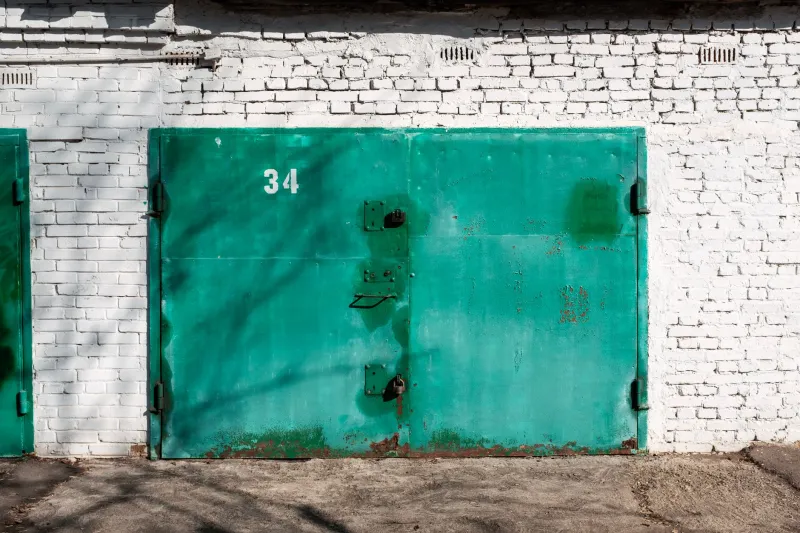
Photo: Mesfet, CC BY-SA 3.0, via Wikimedia Commons
There are few stranger domestic moments than pressing your own garage remote and watching next door's door go up. Or worse, standing in your kitchen while your own garage opens itself because a neighbour has just come home. It sounds like a ghost story for electricians, but remote-control interference is a real and surprisingly ordinary problem in UK garages. The good news is that most cases come down to one of two things — a code clash or a crowded radio band — and neither usually means replacing the whole door.
Start with the boring checks
Before you blame the people over the fence, rule out the obvious. A remote with a stuck button can keep transmitting long after you have put it down. A tired battery can produce odd bursts of signal. Water in the receiver, a faulty wall switch or a keypad with a damp circuit board can all make a door behave as if it has a mind of its own.
If the door is opening at random, treat it as a safety issue first. Unplug the opener or disconnect the battery backup until you have investigated. A garage door that opens without warning is not just annoying; it is a security risk and a potential hazard for anyone nearby.
Fixed codes, rolling codes and the neighbour problem
Older openers often use fixed-code technology. You will know one by the row of tiny DIP switches inside the remote and receiver. Each switch is either on or off, which gives a limited number of combinations. On an eight-switch system that is only 256 possibilities; even twelve switches is not a huge number when you consider how many garages sit close together in a UK street.
If two nearby garages were set to the same code — perhaps by the same installer years ago, or by someone copying a remote — then any remote with that code will open both doors. Some cheap universal remotes can also clone fixed codes, which is why an old system can feel as though it has a mind of its own.
Modern rolling-code systems are different. Each press sends a new code from a huge sequence, so a neighbour's remote should not be able to copy yours simply by being nearby. That does not make them immune to every problem, but it does make accidental code sharing much less likely.
Is it copying, clashing or plain interference?
The clues matter. If your neighbour's remote opens your door only when they press it, you are probably looking at a code clash or a cloned signal. If your door opens at random times, or reacts when a wireless doorbell, security camera or weather station is used, interference is more likely.
A simple test is to note down when it happens. Does it coincide with next door coming home? Does it happen when a particular outdoor light switches on? Does your door open when nobody is using a remote at all? If you can borrow a spare remote that was never paired with your opener and it opens the door, that points towards a receiver that is accepting codes too readily.
You can also check the label on the receiver or opener for a frequency. Many UK systems use 433MHz or 868MHz, and older units may use 40MHz. A receiver that is being swamped by nearby devices on the same band can behave erratically, even if the other devices are not deliberately trying to control it.
A five-minute diagnostic you can do yourself
First, isolate the opener so the door cannot move while you are poking about. Then look inside one of your remotes. If you see DIP switches, you have a fixed-code system. Compare the switch pattern with the receiver if it is accessible and with any spare remotes.
Next, erase the receiver's memory if your manual explains how. This is often a case of holding a button on the receiver until an LED flashes. Then re-pair only the remotes you actually use. If a neighbour's remote still opens the door after that, the receiver is either retaining the old code or accepting a code it should not.
On a fixed-code system, change the DIP switches to a new combination on the receiver and on all your remotes. Avoid obvious patterns such as all switches up or alternating on-off. If the receiver will not accept a new code, it may be time for a replacement rather than more faffing.
For random openings, move the receiver aerial away from metal shelving, mains cables and the back of a metal consumer unit. Keep it straight rather than coiled. If the receiver is old and has no proper filtering, a newer receiver may simply be less easily confused.
Sorting a code clash properly
The cleanest fix is to wipe the receiver's memory and start again. That means every remote that should work gets re-paired, and every remote that should not work is left out. If you have a fixed-code system and a neighbour has the same code, changing your code sorts the problem without any awkward conversation.
If the receiver is old, a rolling-code receiver kit is often the sensible upgrade. It gives you far more code combinations and makes casual copying much harder. A DIY receiver kit might cost somewhere in the region of £50 to £150, while a professional supply-and-fit job is more likely to land between £150 and £300 depending on the opener and access. That is usually cheaper than a new door and often cheaper than repeatedly replacing cheap remotes.
When it is interference rather than a code problem
If the door reacts to all sorts of things — or opens at random with no remote in sight — think interference. Wireless doorbells, cameras, baby monitors, cheap LED drivers and even faulty electrical equipment can put noise onto the same frequency. You are not looking for a villain; you are looking for a pattern.
Do not be tempted by anything advertised as a signal jammer. They are illegal to use in the UK and can interfere with far more than your garage door. If the problem is persistent, a receiver with better filtering or a rolling-code system is the practical route. If the opener itself is elderly and has been repaired several times, replacing it may be more sensible than chasing a fault around an ageing circuit board.
Do not ignore the security side
An uninvited opening is a security problem, even if the cause turns out to be boring. Until it is fixed, use the manual lock if your door has one, or leave the opener isolated. If you rent, tell your landlord rather than trying to fix a receiver that is not yours to alter.
Most cases are solved by erasing the receiver and re-pairing your remotes, or by changing the code on an older fixed-code system. If that does not work, a rolling-code receiver is the grown-up solution. Keep a note of the opener model and frequency, and do not buy a random universal remote from the internet and hope for the best. A little detective work now saves a lot of phantom beeping later.