What the Surveyor Actually Meant About Your Garage Door

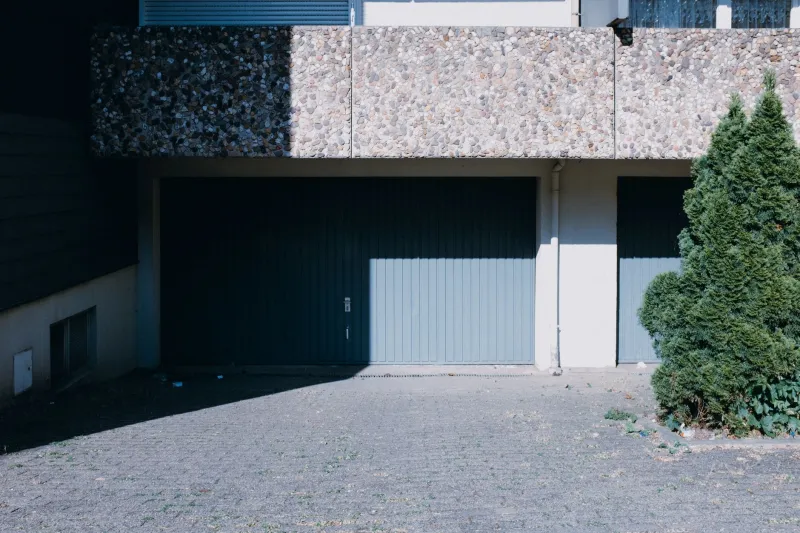
Photo: Richard Waitt, Public domain, via Wikimedia Commons
A garage door rarely gets its own chapter in a UK home survey. More often it turns up as a line or two under the exterior, garage, or outbuildings section — something like ‘garage door appears aged; further investigation recommended’. And because surveys are written to be cautious, that single sentence can land with more weight than it deserves.
The trick is not to ignore it, and not to panic. Read it as a prompt: what exactly was seen, what was not seen, and what would it cost to put right? Whether you are buying or selling, the garage door is usually a negotiation item, not a deal-breaker.
Surveyors are generalists, not garage door specialists
A surveyor is looking at the whole house. They will note obvious defects, safety concerns and anything that looks like it might become expensive. They are not stripping the door down, testing spring tensions or measuring the balance of a sectional door. That is why the wording tends to be hedged: ‘evidence of wear’, ‘unable to test’, ‘recommend further investigation by a specialist’.
That does not mean the report is wrong. It means the report is doing its job — flagging something for a closer look. A Level 2 survey might give you a paragraph; a Level 3 building survey may go further. Neither replaces a garage door engineer’s inspection.
The usual suspects, translated
Rotten bottom rail or frame. Timber doors and timber frames often show decay at the bottom, where water sits. On a survey this sounds grim. In practice, a rotten bottom rail can be a repair rather than a replacement, depending on how far the rot has travelled. If the door is otherwise sound, a joiner may be able to splice in new timber. If the frame has gone soft around the hinges, replacement becomes more likely. Either way, get a quote rather than guessing.
Tired springs or cables. Surveyors sometimes note that a door is heavy to lift or that springs look corroded. This is a genuine safety point, but it is also a routine wear item. Springs have a finite life. A pair of torsion springs on a typical UK up-and-over or sectional door is not a small DIY job — the tension can hurt you — but it is a known repair with a known price range. Ask for a written quote from a garage door firm, not a builder’s estimate.
Missing safety devices. On an automated door, the report may mention the absence of a safety edge or photocells, or that the door does not reverse on contact. This matters. It is also relatively straightforward to upgrade. A modern opener with a safety edge can usually be fitted to a sound door, though very old doors may not be compatible. Treat this as a cost to price in, not a reason to walk away.
A seized or missing lock. A stiff lock or missing handle is often cosmetic and mechanical rather than structural. Sometimes it is just lack of use. Sometimes the door has dropped and the locking rods no longer line up. A locksmith or door engineer can usually sort it, but ask whether the door can be secured properly — especially if the garage connects to the house.
‘Door would not open on inspection day’. This is the line that worries buyers most. It can mean anything from a snapped cable to a seller who has not opened the door in three years. It can also mean the surveyor did not want to force a stiff door. Do not accept ‘it just needs a bit of oil’ as a diagnosis. Ask for the door to be operated in your presence, or for a garage door engineer to attend and provide a report. If the seller will not allow either, price the risk accordingly.
What each finding is actually worth
Think in three buckets: maintenance, repair, and replacement.
Maintenance is cleaning, lubrication, adjusting a track, replacing a handle or lock. This is a weekend’s work or a small call-out. It rarely justifies a price reduction on its own.
Repair is springs, cables, rollers, a bottom rail, a new opener, or safety devices. These are quoteable items. Get two prices and use the middle of the range as a negotiating figure, not the highest.
Replacement is when the door is structurally tired, the frame is rotten, parts are obsolete, or the door is unsafe and cannot be economically brought up to standard. Even then, a standard up-and-over or sectional door is a predictable cost. It is not the same as a new roof.
A useful question for any buyer: would I accept this door if the seller knocked off the cost of the repair? If yes, you are negotiating, not rejecting.
For buyers: what to ask to see
Before you accept a reassuring ‘it’s fine, mate’, ask for evidence. A recent service receipt for the door or opener. A photo or short video of the door opening and closing fully. Confirmation that the manual release has been tested — and that it works. For an automated door, a demonstration of the safety reversal or safety edge. If the door has been painted recently, ask what was underneath.
You are not being difficult. You are doing the same thing you would do for a boiler or an electrical certificate.
For sellers: a short pre-survey checklist
Clear the area in front of and inside the garage door so it can be operated safely. Open and close it yourself a few times; note any grinding, jumping or heavy lifting. Look at the bottom rail for soft timber or rust. Check the lock actually engages. If you have an automated door, test the safety device and make sure the manual release works. Keep any service or installation paperwork to hand. If you know the door is tired, get a repair quote before the surveyor writes vague words that sound worse than the reality.
A survey report is a snapshot, not a verdict. The garage door is one of the more predictable parts of a house to price and fix. Read the wording, ask for a proper inspection where it matters, and negotiate with numbers rather than nerves.